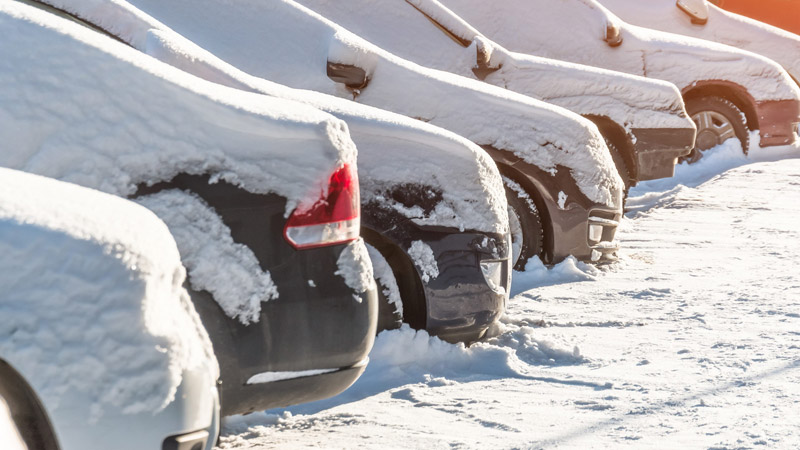
To protect your car while it’s parked at Newark Liberty International Airport (EWR) in winter, do five things before you leave: have the battery tested if it’s three or more years old, set your tire pressure, leave at least half a tank of gas, top off with winter washer fluid, and keep your snow brush and ice scraper inside the car, not in the trunk. When you get back, clear the snow off the whole car, roof included, before you drive. New Jersey law requires it. At 32°F, a battery has only about 65 percent of its normal strength, and tire pressure drops about 1 psi for every 10 degrees.
Winters at EWR bring real snow and long stretches of nights below freezing, which is hard on a car that sits for a week. We’ve run an off-airport lot two to three minutes from the terminals since 1994, open 24 hours a day through every kind of winter. This guide covers what the cold does to a parked car, a quick check you can run for your own trip, and how to handle storms and a snowy return.
A car that sits for a week in the cold isn’t running its engine or recharging its battery, so small weaknesses show up all at once on the day you come back. Here’s what changes as the temperature drops.
| Temperature | Battery strength | Tire pressure |
|---|---|---|
| 70°F | Full strength | Where you set it |
| 32°F | About 65% | About 4 psi lower |
| 0°F | About 40% | About 7 psi lower |
At the same time the battery is weaker, the engine needs more from it. AAA says an engine needs about 30 percent more energy to start at freezing. A fully discharged battery can even freeze at 32°F, while a fully charged one normally won’t. That’s why the battery is the first thing to check before a winter trip.
Fuel matters too. AAA recommends keeping at least half a tank in cold weather to help keep fuel lines from freezing.
Our shuttle meets you at your car when you arrive, and when you come back, it drops you right back at your car. It runs 24 hours a day, 365 days a year. Reserve online from $30 per day, or from $18.99 per day as a free LTP Club member, plus taxes and fees. Reservations are fully refundable until they start.
Choose your travel month, how long you’ll be away, your battery’s age, and what you drive. You’ll get the typical overnight low for that month at Newark, what to do about your battery, and how much tire pressure to expect to lose.
Lows are Newark Liberty’s 1991 to 2020 monthly averages from the National Weather Service. Cold snaps run lower, so treat these as a typical night, not the worst case.
AAA puts the typical car battery’s life in the Northeast at three to five years. If yours is in that range or older, a quick test at an auto parts store or your mechanic is the cheapest insurance you can buy before a winter trip. The install date is usually on a sticker on top of the battery.
Check pressure before you drive, using the number on the sticker inside the driver’s door, not the number on the tire. A car that leaves on a mild day and sits through a cold week can come back to a low tire pressure warning even when nothing is wrong.
Half a tank helps protect your fuel lines, and it means you won’t be hunting for a gas station on the drive home. Fill the washer reservoir with a winter-rated fluid, since road salt and slush will have your windshield coated within a few miles.
A trunk lid or hatch can freeze shut after an ice storm. If your brush and scraper are on the back seat or the floor, you can reach them the moment you open a door.
Some drivers lift their wipers away from the glass so they don’t freeze to the windshield, but that isn’t right for every car, especially those with wipers tucked under the hood line. Some owner’s manuals also warn that a parking brake can freeze in place in cold, wet weather. Your manual is the best guide for both.
If you’re flying somewhere warm, keep a coat and gloves in your carry-on. You may land at 11 p.m. to temperatures in the 20s.
Winter storms can cancel flights at EWR with little notice. Check your flight status before you leave home, and know how your parking handles it.
Our guide to coming back earlier or later than your reservation covers the details, and our cancellation and other policies page has the full terms.
Text your terminal letter and claim check number to the number on the card we gave you, then head to your pickup spot on Level One. The shuttle drops you at your car.
Make sure snow isn’t blocking the exhaust before you start the engine, so fumes don’t build up inside the car. Then run the defroster while you clear the snow. It warms the windshield and makes the ice easier to scrape.
New Jersey law requires drivers to make a reasonable effort to remove snow and ice from the car’s exposed surfaces, including the roof and hood, before driving. Fines run from $25 to $75, and from $200 to $1,000 if snow or ice flies off and injures someone or damages property.
If the tire pressure light is on, it’s most likely the cold. Add air at your first stop, and if one tire is much lower than the others, have it looked at.
Our staff is on site around the clock. If your car won’t start or something looks off, let the team know before you call for roadside help.
Cold weather cuts into an EV’s range, and running the cabin heat on the drive home draws more from the battery. Arrive with plenty of charge, and if you’d like a full battery waiting when you land, we offer EV charging for a flat $5. Tell the shuttle driver your EV needs a charge when you arrive and hand over your key, fob, or card. While you’re away, we move your car to a charging station and make sure it’s fully charged for your return. EVs also have a small 12-volt battery that powers the locks and electronics, and it can weaken in the cold like any car battery. Learn more about our EV charging stations.
Snow, sleet, and 2 a.m. arrivals are part of flying out of Newark in winter. Here’s how we make them easier.
Have the battery tested if it’s three or more years old, set your tire pressure, leave at least half a tank of gas, fill up with winter washer fluid, and keep your snow brush and scraper inside the car. When you return, clear all the snow and ice off the car, including the roof, before you drive.
According to AAA, a car battery has about 65 percent of its normal strength at 32°F and about 40 percent at 0°F. At the same time, an engine needs about 30 percent more energy to start at freezing, which is why older batteries often fail after sitting in the cold.
A healthy battery usually handles it fine. The risk is higher if your battery is more than three years old or already weak, because cold cuts its strength while the car isn’t running to recharge it. Having an older battery tested before a long winter trip is the simplest way to avoid a surprise.
Lifting wipers off the glass can keep them from freezing to the windshield, but it isn’t right for every car, especially those with wipers tucked under the hood line. Check your owner’s manual, and if you leave them down, warm the windshield with the defroster before using them.
AAA recommends keeping at least half a tank in cold weather to help keep fuel lines from freezing. It also means you won’t need to stop for gas right after a late flight.
Yes. New Jersey law requires drivers to make a reasonable effort to remove snow and ice from the vehicle’s exposed surfaces, including the roof, before driving. Fines range from $25 to $75, and from $200 to $1,000 if snow or ice flies off and causes injury or property damage.
At Newark Airport Long Term Parking, if your flight is canceled and moved to the next day, we reopen your reservation at checkout, charge a canceled flight fee of half the daily rate, and you use the same reservation the next day. If your flight is canceled completely, we charge that fee and refund the rest of your prepaid reservation.

 Login
 Sign Up